
Defining chain abstraction in 2026
Chain abstraction is a user experience framework that unifies fragmented blockchain networks into a single interface. It removes the need for users to manage multiple wallets, chains, or gas tokens by handling the complexity behind the scenes. In 2026, this approach has shifted from a novelty to a standard expectation for consumer-facing applications.
Unlike simple bridging, which moves assets between siloed ledgers, chain abstraction focuses on liquidity unification. It allows users to interact with dApps across different environments without understanding the underlying mechanics. The system routes transactions, swaps assets, and pays for gas automatically, often using stablecoins or native tokens from the user's preferred chain.
This distinction matters because bridging only solves the movement of value. Chain abstraction solves the movement of attention and intent. Users no longer need to check which chain a specific application runs on or maintain balances in five different networks. The infrastructure handles the fragmentation, presenting a clean, single-entry point for all interactions.
The result is a seamless experience where the technology recedes into the background. Users focus on what they want to achieve, not the technical steps required to get there. This shift is critical for mass adoption, as it eliminates the steep learning curve that has historically limited blockchain utility.
Why liquidity fragmentation hurts market efficiency
The current multi-chain landscape resembles a global banking system where every country has its own currency, exchange rate, and border control. There are now over 50 active Layer 1 and Layer 2 networks, yet liquidity remains siloed within each ecosystem. This fragmentation forces capital to sit idle rather than circulating freely, creating significant friction for both traders and developers.
When liquidity is fragmented, market efficiency drops. Users must bridge assets across chains, paying high fees and waiting for confirmations that can take hours. More critically, thin order books on smaller chains lead to higher slippage. A trade that costs 0.1% on Ethereum Mainnet might cost 2% or more on a lesser-known L2 due to lack of depth. This capital inefficiency discourages institutional adoption and limits the total addressable market for decentralized applications.
Over 50 active L1/L2 networks exist today, yet liquidity remains siloed, increasing slippage and reducing capital efficiency.
For developers, this fragmentation is equally burdensome. Building a single application that functions seamlessly across multiple chains requires maintaining separate codebases, managing distinct security models, and integrating with various liquidity providers. The result is a web3 experience that feels disjointed and hostile to mainstream users, who expect instant, unified transactions regardless of the underlying infrastructure.
Chain abstraction aims to solve this by treating the underlying blockchain as an invisible utility. Instead of forcing users to choose a chain, abstraction layers route transactions and liquidity automatically, ensuring that capital flows to where it is most efficient. This shift from fragmented silos to unified liquidity is the foundational shift required for the next phase of market growth.
How unified liquidity works
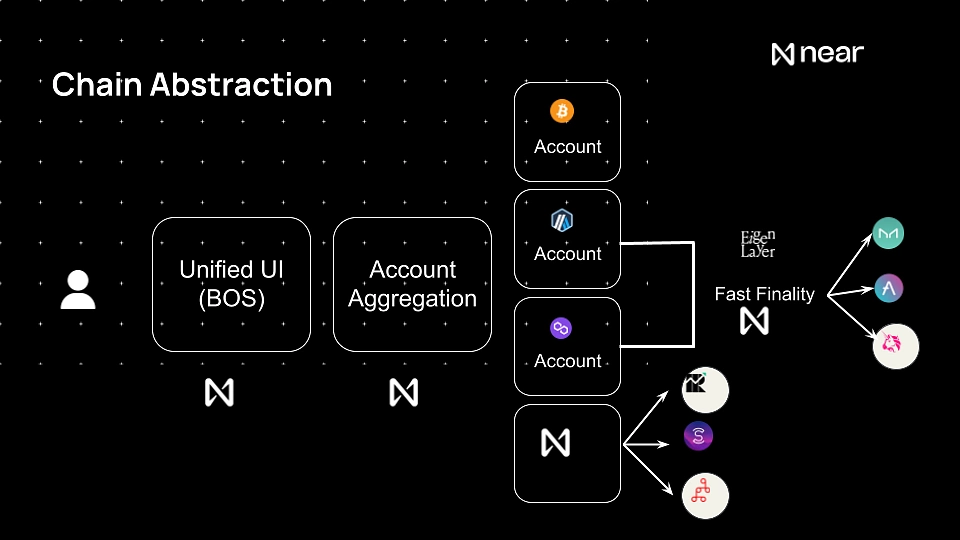
Unified liquidity replaces the old model of moving assets across chains with a system where assets remain in place while their value and utility move on your behalf. Instead of locking tokens in a bridge contract and minting wrapped versions on another chain, chain abstraction uses intent-based systems and cross-chain accounts to execute trades and transfers as single, atomic operations. This approach eliminates the friction of fragmented liquidity pools and the risks associated with multi-hop bridging.
Intent-based execution
Intent-based systems decouple the user from the complex logistics of cross-chain settlement. You sign a single transaction stating what you want to achieve—such as "swap ETH for USDC on Solana"—without specifying how the system should route the assets. Specialized operators, known as solvers, compete to fulfill your intent by finding the most efficient path across available liquidity sources. They handle the underlying mechanics, ensuring that the final state matches your request before the transaction is considered complete.
This mechanism relies on cryptographic proofs to guarantee that the solver has actually executed the trade correctly. If the solver fails to deliver the promised outcome, the transaction simply does not settle, and your original assets remain untouched. This creates a trustless environment where you do not need to vet individual bridges or liquidity providers, as the protocol itself enforces the outcome through on-chain verification.
Cross-chain accounts
Cross-chain accounts provide a persistent identity and state management layer that follows you across different blockchains. Rather than managing separate wallets and addresses for each network, you maintain a single logical account that can interact with multiple chains simultaneously. When you initiate a transaction, the account abstracts away the underlying chain details, routing the request to the appropriate execution layer automatically.
This structure simplifies user experience significantly. You no longer need to worry about gas fees on specific chains or holding native tokens for transaction costs on every network you visit. The account layer handles fee abstraction and settlement, allowing you to focus on the application logic rather than the infrastructure. By unifying these interactions, chain abstraction makes multi-chain ecosystems feel like a single, cohesive network.
Comparing the models
The shift from traditional bridging to unified liquidity represents a fundamental change in how value moves through the ecosystem. Traditional methods require manual intervention, multiple steps, and significant trust in bridge operators. Unified liquidity automates this process, reducing costs and improving speed.
| Feature | Traditional Bridging | Unified Liquidity |
|---|---|---|
| Speed | Slow (minutes to hours) | Instant (seconds) |
| Liquidity Source | Fragmented across chains | Aggregated and unified |
| User Friction | High (multiple approvals) | Low (single intent) |
| Risk Exposure | High (bridge hacks) | Lower (atomic settlement) |
Implementation checklist
When evaluating chain abstraction solutions, consider the following factors to ensure they meet your needs:
- Verify that the system supports atomic settlement to prevent loss of funds if execution fails.
- Check for gas fee abstraction to simplify transaction costs across different networks.
- Ensure the intent solver network is decentralized to avoid single points of failure.
- Confirm that the cross-chain account supports your preferred wallets and dApps.
Market impact and adoption trends
Chain abstraction is shifting from a technical experiment to a measurable market force. In 2026, the primary value proposition is no longer just interoperability; it is the consolidation of liquidity that was previously trapped across fragmented networks. This shift is driving a new wave of institutional interest, as capital allocators seek environments where cross-chain friction no longer erodes returns or complicates custody.
The market is responding to this utility with clear price action. Assets built on chain abstraction layers are seeing increased volume as they serve as the settlement rails for unified liquidity. The following chart illustrates the recent sentiment and trading activity for a leading protocol token in this space, reflecting the growing demand for seamless cross-chain infrastructure.
Institutional adoption is accelerating because chain abstraction removes the operational overhead of managing multi-chain wallets and bridging assets manually. For traditional finance players, this means they can access decentralized yield and liquidity without the complex user experience that previously deterred large-scale capital deployment. The focus is now on standardized interfaces that hide the underlying chain complexity.
While the technology matures, the market impact is visible in the consolidation of trading pairs and the rise of aggregated liquidity pools. Traders are moving away from isolated DEXs on individual chains toward unified venues that source depth from across the ecosystem. This trend suggests that the "fragmentation tax" is being eliminated, allowing capital to flow to its highest-yielding opportunities regardless of the underlying blockchain.
Security trade-offs in unified liquidity
Chain abstraction promises to dissolve the friction of multi-chain interactions, but it simultaneously concentrates risk. By routing transactions through intermediary layers and cross-chain bridges, the attack surface expands significantly. A vulnerability in a single abstraction layer or bridge contract can expose liquidity across multiple networks, turning a localized bug into a systemic crisis.
The primary danger lies in smart contract risk. Unified liquidity protocols often rely on complex logic to manage state across disparate chains. If the code governing these cross-chain messages is flawed, attackers can exploit the trust assumptions between chains. Recent history shows that bridge exploits remain one of the most costly vectors in crypto, draining billions by manipulating the very interoperability tools designed to help users.
Mitigating these threats requires rigorous verification. Users should prioritize protocols with transparent, multi-sig governance and regular third-party audits. Relying on unverified cross-chain routers is akin to leaving the front door unlocked while installing a high-end lock on the back. The convenience of unified liquidity is valuable, but it demands a higher standard of security diligence to ensure funds remain safe.
No comments yet. Be the first to share your thoughts!