
Defining the chain abstraction shift
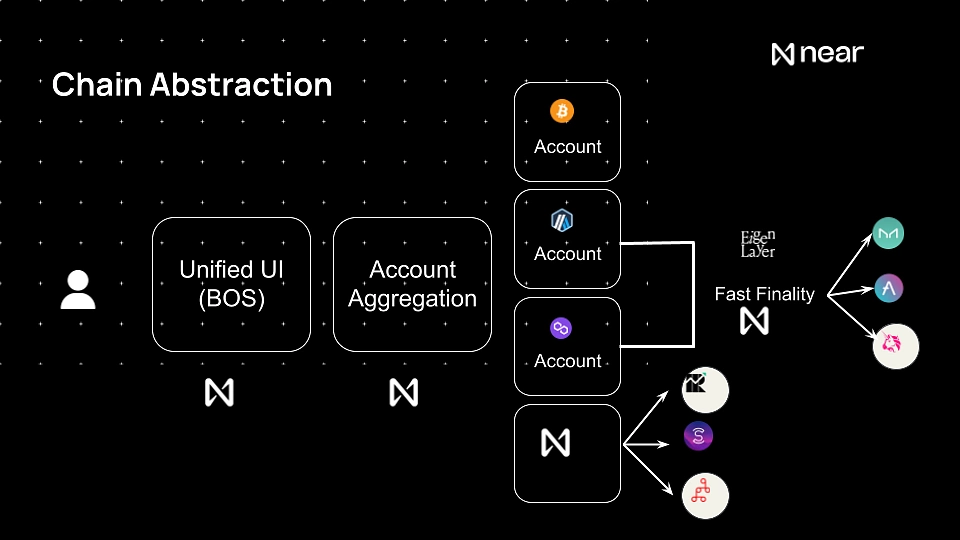
Chain abstraction is the design goal of making users interact with blockchain applications without ever picking, seeing, or thinking about which specific network they are using. Instead of managing multiple wallets, bridging assets between incompatible ledgers, or guessing which chain holds the liquidity they need, the user interacts with a single, unified interface. The underlying complexity of multi-chain infrastructure is handled by the protocol, not the user.
This shift addresses the primary friction in decentralized finance: liquidity fragmentation. Currently, capital is siloed across dozens of separate blockchains, each with its own native tokens, gas mechanics, and security models. Chain abstraction removes these UX frictions, creating a seamless experience where the user’s intent—whether swapping, lending, or trading—takes precedence over the technical execution path. As defined by NEAR, this allows users to work across all chains as if they were a single system [src-serp-1].
The implications for market efficiency are significant. When users no longer face the cognitive load of navigating multiple ecosystems, capital flows more freely toward yield and utility rather than staying trapped in isolated chains. This unification transforms the fragmented blockchain landscape into a cohesive financial layer, where the user experience is indistinguishable from centralized applications, but the underlying settlement remains decentralized.
Unified liquidity across abstracted chains
Chain abstraction addresses the fragmentation that has historically stifled capital efficiency. Instead of forcing users to manually bridge assets or swap tokens on separate networks, these protocols aggregate liquidity into a single, coherent pool. The result is a unified market where depth from multiple chains contributes to a shared liquidity layer.
This mechanism operates by routing transactions through a network of interoperable bridges and relayers. When a user interacts with a decentralized application, the backend handles the complex cross-chain settlement in the background. The user sees only a single interface, while the protocol ensures the asset arrives at the destination chain without intermediate stops.
The shift from fragmented silos to a connected mesh changes the economic dynamics. Liquidity no longer sits idle on low-volume chains; it becomes accessible to any user regardless of their origin. This reduces slippage and improves pricing for all participants, effectively solving the "thin market" problem that plagues many alt-chains.
| Feature | Traditional Multi-Chain UX | Abstracted Chain UX |
|---|---|---|
| Asset Movement | Manual bridging required | Automatic routing |
| Token Usage | Must hold native chain token | Use any supported token |
| Liquidity Access | Fragmented across isolated pools | Aggregated into unified depth |
| User Interface | Multiple apps and wallets | Single sign-on interface |
By removing the friction of cross-chain movement, abstracted liquidity creates a more resilient market structure. Capital flows to where it is needed most, rather than being trapped by technical barriers. This unity is the foundation for the next generation of decentralized finance.
Market impact on cross-chain DeFi
Chain abstraction shifts the focus from technical interoperability to financial efficiency. By unifying fragmented liquidity pools, these protocols allow capital to flow freely across networks without the friction of manual bridging or wrapped assets. This consolidation directly addresses the liquidity fragmentation that has historically depressed yields and increased trading costs in decentralized finance.
Unified liquidity improves capital efficiency by creating a deeper, more resilient order book. When liquidity is pooled rather than siloed, slippage decreases significantly for large transactions. This stability is essential for attracting institutional capital, which requires predictable execution prices and robust market depth. Simplified UX and streamlined compliance layers further reduce the barrier to entry for traditional finance players seeking exposure to DeFi.
The market response to this consolidation is evident in trading volume trends. As users migrate to interfaces that hide chain complexity, liquidity concentrates in abstraction-native protocols. This shift pressures legacy bridges and fragmented DEXs to adapt or lose relevance. The following chart illustrates the broader market context, reflecting how investor sentiment correlates with the maturation of cross-chain infrastructure.
Security Models in Abstracted Systems
Chain abstraction shifts the burden of security from the user to the infrastructure. When a single interface manages transactions across multiple ledgers, the system must guarantee that an intent executed on one chain is reliably settled on another. This introduces a new trust layer: the intent solver.
The solver acts as a relay, verifying that the necessary conditions are met before broadcasting a transaction to the destination chain. If the solver fails to deliver or the destination chain reverts the transaction, the user’s funds are not lost—they are returned to the source chain. This atomic settlement model ensures that liquidity remains intact even when cross-chain finality is not instantaneous.
Finality remains the anchor. While the abstraction layer provides a seamless user experience, the cryptographic proofs and consensus mechanisms of the underlying blockchains (such as Ethereum’s PoS or Solana’s Tower BFT) still provide the ultimate security guarantee. The solver does not create new security properties; it orchestrates existing ones.
This architecture requires rigorous auditing of the solver’s logic. A bug in the intent routing code can lead to front-running or sandwich attacks, even if the underlying chains are secure. Therefore, the security of an abstracted system is only as strong as its weakest link: the bridge between the user’s intent and the chain’s finality.
Drivers of Chain Abstraction Adoption in 2026
The transition from fragmented liquidity to unified access is accelerating. In 2026, three specific forces are converging to make chain abstraction a standard rather than an experiment: AI integration, institutional demand for simplified UX, and the maturation of intent-centric architectures.
AI Integration
AI agents require frictionless access to on-chain assets to execute trades and manage portfolios autonomously. Chain abstraction eliminates the complexity of managing multiple wallets and bridging assets across different networks. As noted by Near Protocol, this architecture allows AI to interact with assets, applications, and services across multiple chains as if they were a single system. This simplification is critical for scaling autonomous economic activity.
Institutional Demand
Institutional investors prioritize security and compliance over novelty. They are unlikely to adopt fragmented blockchains that require complex manual interventions. Chain abstraction provides a unified interface that hides the underlying technical complexity. This allows institutions to interact with blockchain applications without ever picking, seeing, or thinking about which network is processing their transaction. The result is a user experience that matches the simplicity of traditional finance while retaining the benefits of decentralized infrastructure.
Intent-Centric Architectures
Intent-centric models shift the burden of execution from the user to the network. Instead of manually selecting gas tokens and bridge providers, users declare their desired outcome, and solvers compete to fulfill it. This approach has matured significantly in 2026, with major decentralized exchanges integrating abstracted swaps directly into their interfaces. The liquidity fragmentation that once plagued multi-chain ecosystems is being resolved by these intelligent routing mechanisms, ensuring that users get the best execution regardless of where the liquidity resides.

No comments yet. Be the first to share your thoughts!