
Defining chain abstraction in 2026
Use this section to make the Chain Abstraction decision easier to compare in real life, not just on paper. Start with the reader's actual constraint, then separate must-have requirements from details that are merely nice to have. A practical choice should survive normal use, maintenance, timing, and budget. If a recommendation only works in an ideal situation, call that out plainly and give the reader a fallback path.
The simplest way to use this section is to write down the must-have criteria first, then compare each option against those criteria before weighing nice-to-have features.
How unified liquidity replaces fragmented bridges
Traditional cross-chain bridges operate on a simple but costly principle: lock. To move assets from Ethereum to Solana, you deposit the token into a smart contract on Ethereum, which locks it in place. A separate protocol then mints a wrapped equivalent on the destination chain. This process requires multiple transactions, exposes users to smart contract risk, and creates liquidity silos where capital cannot flow freely between networks.
Chain abstraction changes this by treating the entire multi-chain ecosystem as a single liquidity pool. Instead of locking assets, unified liquidity protocols use advanced routing and settlement layers to transfer value across chains without explicit bridging actions. The user interacts with one interface, and the underlying infrastructure handles the complexity of sourcing liquidity from the most efficient source, whether that is a native chain, a layer-2, or an adjacent network.
This shift mirrors how modern payment networks operate. When you use a credit card online, you do not need to know which bank holds your funds or how the transaction settles between institutions. Chain abstraction applies this same logic to crypto, removing the friction of managing multiple wallets, gas tokens, and bridge protocols. The result is a seamless experience where liquidity is not trapped on isolated chains but flows dynamically to where it is needed.
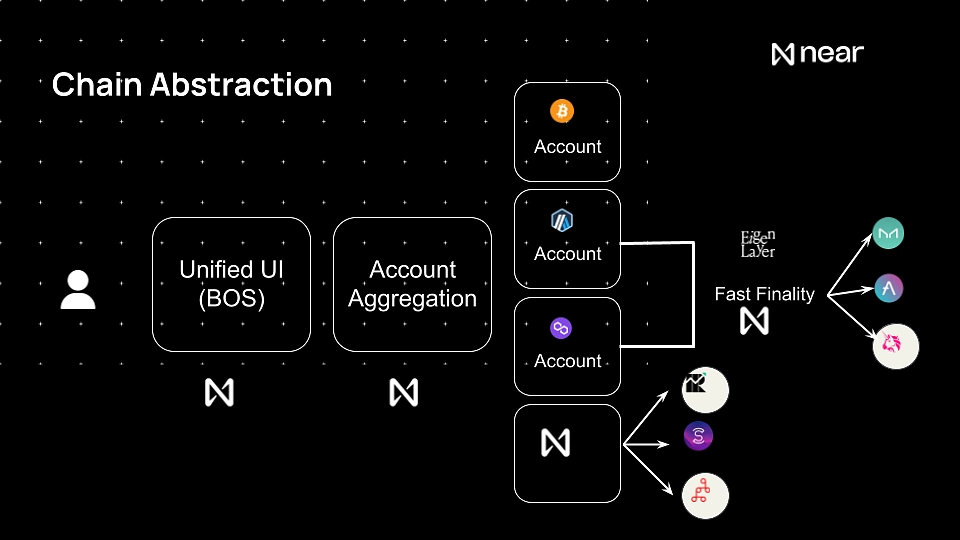
Comparing interoperability protocol models
Chain abstraction does not rely on a single architectural pattern. Instead, three dominant models compete to solve cross-chain friction: intent-based systems, universal accounts, and cross-chain messaging bridges. Each approach balances security, user experience, and capital efficiency differently.
Understanding these differences helps determine which protocol fits specific use cases. Intent-based solutions prioritize user agency by allowing off-chain solvers to find the best execution path. Universal accounts abstract the underlying chain identity, making multi-chain assets feel like a single balance. Cross-chain messaging focuses on secure communication between contracts, often requiring more manual user steps but offering greater composability.
The table below compares the core characteristics of these leading models.
| Model | Security Model | User Experience | Supported Chains |
|---|---|---|---|
| Intent-Based | Solver-dependent; relies on economic finality | Low friction; user submits goal, not method | Broad; limited by solver liquidity |
| Universal Accounts | Wrapped asset custody; bridge risk | Seamless; single signature across chains | Moderate; requires wrapped token deployment |
| Cross-Chain Messaging | Light client verification; optimistic fraud proofs | Higher friction; explicit bridge actions | High; native to most L2s and L1s |
Chain abstraction versus account abstraction
Chain abstraction and account abstraction solve different problems in the blockchain stack, though they often work together to create a smoother user experience. Understanding the distinction helps clarify why both are necessary for the next generation of decentralized applications.
Chain abstraction operates at the network level. It unifies fragmented blockchain networks into a single interface, allowing users to interact with multiple chains without managing separate wallets, bridging assets manually, or switching networks in their browser. As noted by Chainlink, this framework hides the underlying complexity of multi-chain infrastructure, making the network layer invisible to the end user. The goal is seamless interoperability where the user sees one ecosystem rather than a fragmented landscape of isolated silos.
Account abstraction, defined by ERC-4337, focuses on the wallet level. It improves user experience by replacing the traditional single-key signature model with smart contract wallets. This allows for features like social recovery, session keys, and batched transactions. Instead of worrying about private keys for every single action, users can set up more flexible security models that feel more like traditional app logins.
These two concepts are complementary. Chain abstraction handles the "where"—which network is processing the transaction—while account abstraction handles the "how"—how the user signs and authorizes it. A fully abstracted experience likely requires both: a smart contract wallet (account abstraction) that can sign transactions across any chain (chain abstraction) without the user ever knowing which chain is active. This combination moves crypto closer to the seamless, unified experience of Web2, where the underlying infrastructure disappears into the background.
Security risks in abstracted networks
Chain abstraction promises simplicity, but it often centralizes risk rather than eliminating it. By routing transactions through intent solvers and relayers, users trade direct control for convenience, creating a single point of failure that did not exist in isolated chains.
Intent solvers act as the new gatekeepers. If an solver is compromised, the entire abstraction layer collapses, exposing user funds that were previously distributed across fragmented networks. This shift concentrates attack surfaces on a few critical infrastructure providers.
Smart contract vulnerabilities in these solvers carry amplified consequences. A bug in a bridge or solver contract can drain liquidity from multiple chains simultaneously, turning a localized exploit into a systemic crisis.
Trust assumptions have also changed. Users must now trust the honesty and solvency of solvers, not just the underlying blockchain code. This introduces counterparty risk that was absent in traditional non-custodial DeFi interactions.
Adoption checklist for chain abstraction
Before committing capital or building on a chain abstraction layer, developers and investors must verify that the protocol actually removes friction without introducing new attack surfaces. The goal is to make the underlying blockchain invisible to the user, as defined by the NEAR Foundation and Eco.

Chain abstraction introduces complex routing logic that can hide vulnerabilities. Require independent, public audits of the abstraction layer’s smart contracts. Look for formal verification of the cross-chain message passing mechanisms to ensure assets cannot be trapped or double-spent during state transitions.

Abstraction is useless if users face high slippage or gas costs. Check if the protocol aggregates liquidity from multiple sources to provide deep, efficient pools. Shallow liquidity on a single chain defeats the purpose of unifying fragmented networks.
The core value proposition is removing the need to manage multiple wallets or networks. Evaluate the user journey: can a user sign a single transaction regardless of the target chain? If the user still needs to bridge assets or switch networks manually, the abstraction is incomplete.
No comments yet. Be the first to share your thoughts!