
What chain abstraction actually means
Chain abstraction is the design goal of making users interact with blockchain applications without ever picking, seeing, or thinking about the underlying network. It is not a new blockchain, nor is it a single protocol. Instead, it is a design philosophy that makes underlying chains invisible to the end user, allowing them to focus entirely on the core experience—whether that is browsing digital art, trading assets, or sending payments.
To understand this distinction, it helps to contrast abstraction with traditional bridging. In a multi-chain world without abstraction, a user must manually select a network, pay gas fees in a specific native token, and execute transactions across bridges to move assets. This process is fragmented and technically demanding. Chain abstraction removes this friction by handling network switching and gas management behind the scenes. The user sees a unified interface; the complexity is buried in the infrastructure layer.
This shift transforms the user experience from a technical chore into a seamless interaction. As noted in NEAR’s documentation on the topic, with chain abstraction, both developers and users can focus on the core utility rather than the mechanics of interoperability. The blockchain becomes a utility like electricity: you plug in and use it, without needing to know which power plant generated the energy or how the grid balanced the load.
For the market, this means that the competitive advantage will no longer belong solely to chains with the highest TVL or lowest gas fees. Instead, it will belong to the applications and protocols that successfully abstract away the multi-chain complexity. The goal is to make the "chain" irrelevant to the end user, creating a unified digital economy where value flows freely regardless of where it is stored.
The Fragmentation Crisis in Crypto
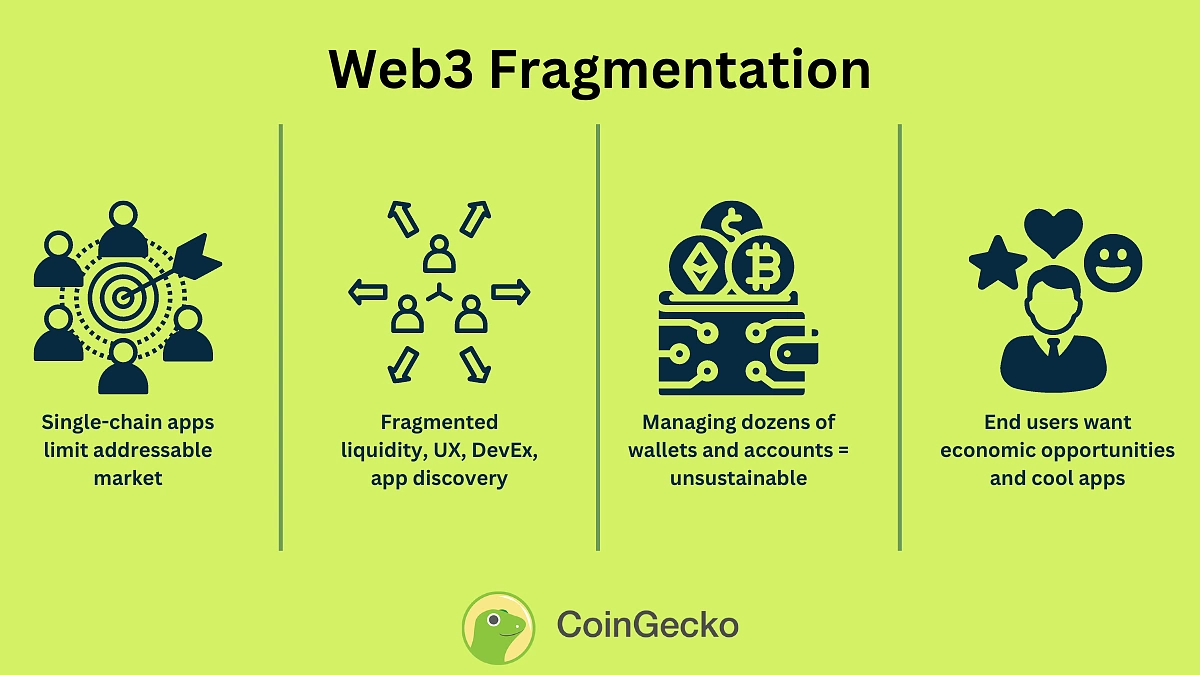
The promise of blockchain technology has collided with a hard reality: the current multi-chain landscape is too complex for mainstream adoption. Instead of a unified financial network, users face a fractured ecosystem defined by liquidity silos and wallet sprawl. This fragmentation creates friction that blocks mass adoption, turning simple transactions into complex engineering challenges.
Today, digital assets are trapped across dozens of isolated networks. Liquidity that could serve the entire market is stuck in silos, reducing efficiency and increasing slippage for everyone. Users must manually bridge funds, manage multiple gas tokens, and navigate different user experiences for every chain they touch. This isn't just an inconvenience; it's a structural barrier that keeps crypto on the sidelines of the broader economy.
The user experience suffers equally. The average crypto user now manages more than three wallets and interacts with five or more distinct networks to participate in the market. This sprawl increases security risks, confuses newcomers, and creates a steep learning curve that turns away potential users. As Safe describes it, the goal is to make these blockchains invisible to end-users, yet the current status quo demands constant visibility and management.
This friction is unsustainable. The industry cannot grow if every interaction requires technical expertise. The fragmentation crisis isn't just a technical debt; it's a business model flaw that prioritizes developer sovereignty over user utility. Until liquidity and identity are unified, crypto will remain a niche experiment rather than a global standard.
How intents replace manual bridging
The shift from manual bridging to intent-based execution is the technical core of chain abstraction. In a traditional multi-chain workflow, a user must actively manage liquidity, select routes, and execute multiple transactions across different networks. Intent-based systems flip this model: the user declares a high-level goal, such as "swap USDC for ETH on Base," and delegates the complex logistics to a network of off-chain solvers. This abstraction layer handles the cross-chain settlement, allowing the user to interact with a single interface while the backend manages the atomic swaps and bridge transfers.
To understand the operational difference, consider the contrast between legacy bridging and modern intent execution. The following comparison highlights how solvers reduce friction and risk.
| Feature | Manual Bridging | Intent-Based Execution |
|---|
Solvers compete to fulfill these intents by finding the most efficient path across liquidity pools and bridges. They use off-chain computation to optimize for speed and cost, then submit a signed transaction to the target chain only when the conditions are met. If a solver cannot fulfill the intent within the specified parameters, the transaction simply does not execute, protecting the user from failed transfers or unfavorable exchange rates. This mechanism transforms cross-chain interactions from a series of risky, manual steps into a reliable, automated service.
This approach aligns with the broader goal of chain abstraction: making blockchain infrastructure invisible to the end user. By hiding the complexity of multi-chain logistics, developers can build applications that feel like single-chain dApps, even when they draw liquidity and data from dozens of networks. The result is a more intuitive experience that prioritizes user intent over technical navigation.
Unified accounts and smart wallets
Chain abstraction moves the complexity from the user interface to the wallet layer. Instead of juggling multiple addresses and bridging assets manually, a single identity—powered by Account Abstraction (ERC-4337)—spans across chains. This unified account acts as a smart contract that manages your keys and transactions, making the underlying blockchain infrastructure invisible.
The result is a seamless experience where you interact with decentralized applications without worrying about which chain you are on. The wallet handles the routing, asset conversion, and gas payments in the background. As Safe.eth describes, this process makes blockchains invisible to end-users, allowing you to focus on the core activity, whether that’s trading art or managing DeFi positions.
This architecture enables powerful features like social recovery and gas sponsorship. If you lose your device, trusted contacts can help restore access to your unified account without needing a seed phrase. Additionally, sponsors can pay transaction fees on your behalf, removing the friction of needing native gas tokens for every chain.
What a chain-abstracted wallet handles
- Social login and recovery: Access your account with familiar methods and recover it via trusted contacts.
- Gas abstraction: Pay fees in any token or have them sponsored, eliminating the need for native gas on every chain.
- Cross-chain balance view: See your total net worth across multiple networks in a single dashboard.
-
Social login and recovery
-
Gas abstraction
-
Cross-chain balance view
Market Impact and Adoption Metrics
Chain abstraction shifts the value proposition from technical novelty to daily utility. By removing the friction of bridging, gas management, and cross-chain swaps, protocols can finally treat blockchain access as an invisible layer rather than a user burden. This shift directly correlates with higher retention rates and increased total value locked (TVL) as users no longer need to manually manage liquidity across fragmented networks.
The financial implications are measurable. When transaction complexity drops, retail onboarding accelerates. We are seeing early signals of this in protocols that have integrated abstracted accounts, where user growth outpaces traditional wallet-based models. The market is rewarding this efficiency, with capital flowing toward ecosystems that prioritize seamless interaction over chain-specific incentives.
To contextualize this growth within the broader crypto market, we can look at the current price action of Ethereum. As the settlement layer for many abstraction solutions, ETH's performance often mirrors the health of the underlying infrastructure.

This visualization highlights how Ethereum's volatility and volume trends often precede or accompany shifts in abstraction-related activity. As the market matures, the correlation between smooth user experience and sustained capital inflow will likely strengthen, making chain abstraction a critical component for long-term market stability.
Common questions about chain abstraction
Chain abstraction aims to hide the complexity of multi-chain infrastructure, but it raises specific concerns about security, costs, and the evolution of existing tools. Here are the most frequent questions users ask.
Market context
Understanding the broader market helps contextualize the technical shifts. The following chart shows recent price action for a major layer-1 asset, reflecting the volatility and institutional interest driving infrastructure innovation.
The transition away from fragmented liquidity toward unified experiences is a key driver of adoption. As infrastructure matures, the friction of managing multiple wallets and networks will likely diminish, making the underlying chain details irrelevant to the average user.
No comments yet. Be the first to share your thoughts!