
What chain abstraction means in 2026
Chain abstraction is a user experience framework that unifies fragmented blockchain networks into a single, coherent interface. Rather than treating each blockchain as an isolated silo, this approach shifts the complexity of interoperability from the user to the backend infrastructure. The goal is simple: users interact with applications without ever needing to pick, see, or think about which specific chain they are using.
This concept is distinct from simple bridging. Traditional bridges require users to manually move assets between wallets and networks, a process fraught with friction and risk. Chain abstraction automates this liquidity routing behind the scenes. It is also different from account abstraction, which focuses on improving individual wallet security and transaction signing. While account abstraction upgrades the user’s interface, chain abstraction upgrades the network’s connectivity.
By hiding the underlying blockchain complexity, applications can offer native-like experiences regardless of the asset’s origin. This unification is critical for mass adoption, as it removes the cognitive load of managing multiple networks. The result is a digital environment where the technology recedes into the background, leaving only the utility and value of the application itself.
How intent-based architectures replace bridges
Chain abstraction works by separating what you want from how it happens. Instead of manually bridging assets across different networks, you submit an intent—a statement of your desired outcome. Solvers then compete to fulfill that request using the most efficient path available. This removes the need for you to understand which blockchain holds the liquidity or which bridge has the best rates.
The process begins when you sign a transaction that declares your goal. For example, you might want to swap USDC on Ethereum for ETH on Arbitrum. Rather than executing two separate transactions and paying fees on both chains, you sign one intent. Solvers, which are specialized agents, monitor these intents and bid to fulfill them. They use a combination of liquidity pools, bridges, and atomic swaps to complete the trade.
This model shifts the complexity from the user to the solver network. Solvers are incentivized to find the cheapest and fastest route because they profit from the spread between the user's intent and the actual execution cost. If a solver fails to deliver, the user's funds remain secure. This creates a competitive market for cross-chain execution, driving down costs and improving reliability.
The result is a seamless experience that feels like using a single blockchain. You don't see the underlying fragmentation. You just see your assets arrive where you need them. This is the core promise of chain abstraction: removing friction without sacrificing security or decentralization.

Technical context
Account abstraction vs. chain abstraction
The terms sound similar, but they solve different problems. Account abstraction (AA) upgrades the wallet itself. It lets users pay gas in stablecoins, skip seed phrases, and recover accounts via social login. The goal is a smoother sign-in experience. Chain abstraction (CA) upgrades the network routing. It lets users send tokens to any chain without manually bridging assets or switching networks. The goal is a unified liquidity layer.
Think of AA as the car’s dashboard and CA as the road system. AA makes the vehicle easier to drive. CA ensures the roads connect seamlessly so you don’t have to stop at every border. You can have one without the other, but the full vision requires both.
| Feature | Account Abstraction (AA) | Chain Abstraction (CA) |
|---|---|---|
| Primary Focus | Wallet interface & user identity | Network routing & asset liquidity |
| Key Mechanism | ERC-4337 smart accounts | Cross-chain messaging & unified liquidity |
| User Benefit | Gasless transactions, account recovery | Single balance across all chains |
| Security Model | Social recovery, session keys | Intent-based routing, atomic swaps |
AA relies on smart contract wallets to replace the traditional EOAs (Externally Owned Accounts). CA relies on intent-centric protocols to route transactions across fragmented ecosystems. Together, they hide the complexity of blockchain infrastructure from the end user.
| Focus | Mechanism | Benefit |
|---|---|---|
| Wallet Interface | ERC-4337 | Gasless txs, recovery |
| Network Routing | Cross-chain messaging | Unified liquidity |
Leading implementations and protocols
The shift toward chain abstraction is no longer theoretical; it is being built by specific protocols that prioritize different aspects of user experience and developer infrastructure. In 2026, the landscape is defined by three distinct approaches: NEAR’s cryptographic signature layer, Particle Network’s account unification, and River’s full-chain integration model. Each solves the fragmentation problem by hiding chain complexity behind a single, coherent interface.
NEAR: Chain Signatures
NEAR Protocol approaches abstraction through its Chain Signatures framework, which allows smart contracts on NEAR to sign messages on other chains without exposing private keys. This mechanism enables cross-chain applications to function as if they were operating on a single network, significantly reducing the friction of managing multiple wallets and bridging assets manually.
Particle Network: Universal Accounts
Particle Network focuses on account-level abstraction with its Universal Accounts. By leveraging ERC-7702 standards, it allows any wallet to interact with any dApp across any chain as a single identity. This approach removes the need for users to understand which chain they are on or to hold native gas tokens for every network they wish to use.
River: Full-Chain Integration
River represents a more aggressive shift from "multi-chain parallelism" to "full-chain integration." Its architecture aims to unify the entire blockchain ecosystem into a single logical layer, allowing users to transact seamlessly regardless of the underlying chain. This model treats all chains as a single resource pool, abstracting away the concept of "cross-chain" entirely.
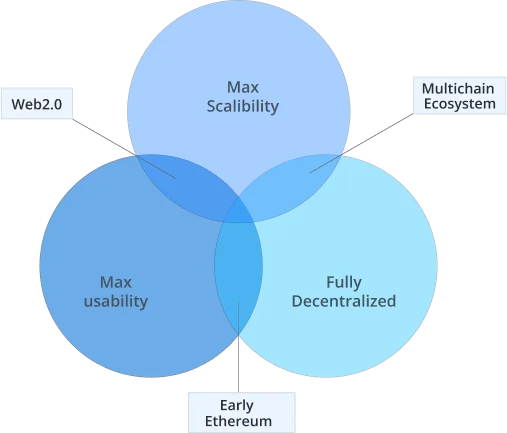
The hidden costs of abstraction
Chain abstraction solves the user experience problem by hiding the modular mess, but it does not eliminate complexity. Instead, it trades visible friction for developer burden. As one community analysis notes, the total complexity remains the same; it simply moves from the user’s wallet to the backend infrastructure. This shift creates a new set of risks that developers must manage.
Developer complexity and solver centralization
The primary tradeoff is the concentration of power. To make cross-chain transactions feel instant and cheap, abstraction layers rely on "solvers"—off-chain entities that bundle and route transactions. While this improves speed, it introduces centralization risks. If a few major solvers dominate the market, they become single points of failure or censorship. Developers must now build trust models around these intermediaries, adding a layer of security auditing that did not exist in native chain interactions.
Monitoring real-time market conditions
For applications built on these abstractions, understanding underlying asset volatility is critical. Solvers often require collateral or gas tokens from specific chains to operate. A sudden drop in the value of a native asset can break solver incentives or cause transaction failures. Developers need to monitor these shifts in real time to ensure their applications remain solvent and responsive during market stress.
Infrastructure gaps remain
Despite these advances, significant gaps persist. Standardization is still fragmented, with different abstraction protocols using incompatible message-passing standards. This forces developers to write custom adapters for each new chain they support, slowing down deployment. Security audits for these complex, multi-layered systems are rare and expensive. Until a unified standard emerges, the promise of seamless cross-chain interaction will remain partially theoretical, limited by the current state of developer tooling and solver decentralization.
No comments yet. Be the first to share your thoughts!