
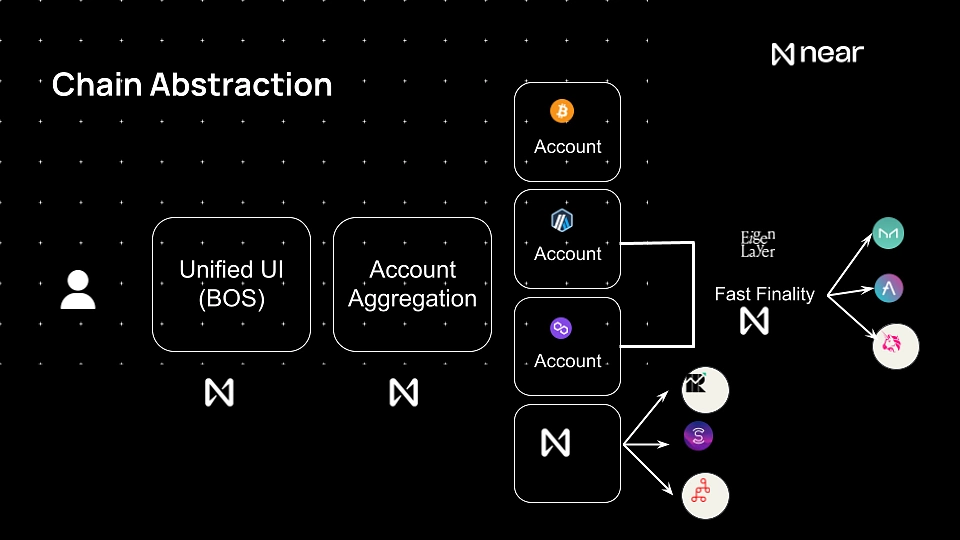
What chain abstraction actually means
Chain abstraction is a user experience framework designed to unify fragmented blockchain networks into a single, cohesive interface. It operates as a layer that sits above existing networks, removing the operational frictions typically associated with managing multiple blockchains. The goal is to distance the end user from the underlying infrastructure, allowing them to interact with decentralized applications without ever picking, seeing, or thinking about which chain they are on eco.com.
In the current fragmented reality, users must manually select networks, bridge assets between chains, and hold native tokens for gas fees on every different ecosystem. This creates a high barrier to entry that mirrors the early internet’s clunky routing protocols. Chain abstraction solves this by handling network selection, bridging, and gas fee abstraction in the background. The user simply initiates a transaction, and the abstraction layer manages the cross-chain execution seamlessly.
This shift transforms blockchain from a complex technical stack into a simple utility. Instead of managing wallets across Ethereum, Solana, and Base, users interact with a single account. This unification is critical for mass adoption, as it removes the cognitive load and security risks associated with manual cross-chain transfers. By hiding the complexity, chain abstraction allows the value of decentralized applications to shine through without the friction of multi-chain logistics.
How the infrastructure hides complexity
Chain abstraction removes the friction of multi-chain interactions by shifting the burden of execution from the user to the infrastructure. Instead of manually bridging assets or switching networks, a single transaction intent is routed across multiple blockchains to find the most efficient path. The user interacts with a unified interface, while the backend handles the complex logistics of settlement, liquidity, and gas payment.
Intent-based architectures
Intent-based architectures decouple transaction submission from execution. Users sign an intent—a signed message stating their desired outcome—rather than a specific sequence of blockchain operations. A network of solvers then competes to fulfill this intent. Solvers aggregate liquidity, calculate optimal routes, and execute the necessary cross-chain steps. This model ensures that the user gets the best possible price and speed without needing to understand the underlying mechanics of liquidity fragmentation.
Account abstraction
Account abstraction (ERC-4337) upgrades the standard Ethereum account from a simple key-pair holder to a smart contract wallet. This upgrade enables features like social recovery, multi-signature requirements, and, crucially, the ability to pay transaction fees in any supported token, not just the native gas currency. In the context of chain abstraction, account abstraction allows a user to pay for a transaction on Chain A using an asset held on Chain B. The infrastructure handles the swap and cross-chain transfer in the background, creating a seamless experience.
Cross-chain messaging
Cross-chain messaging protocols, such as CCIP or LayerZero, provide the communication layer that connects disparate blockchains. These protocols allow smart contracts on one chain to trigger actions on another. Chain abstraction layers wrap these messaging protocols with higher-level logic. They monitor the state of multiple chains, detect when a transaction needs to be finalized, and ensure atomicity. This means that if part of a multi-chain transaction fails, the entire process is rolled back, protecting the user from partial executions or lost funds.
What this means for the user
For the end user, chain abstraction means the underlying blockchain infrastructure becomes invisible. You don't need to know which chain you're on, what the gas price is, or how to bridge assets. You simply interact with the application as if it were a centralized service, but with the security and transparency of decentralized infrastructure. This shift is critical for mass adoption, as it removes the technical barriers that currently limit crypto to a niche audience of technically proficient users.
- Unified Experience: Interact with multiple chains through a single interface.
- Automatic Routing: Transactions are routed to the most efficient chain automatically.
- Flexible Payments: Pay fees with any supported asset, not just the native gas token.
- Enhanced Security: Atomic transactions ensure that cross-chain operations are either fully completed or fully rolled back.
Comparing abstraction models and choices that change the plan
The market for chain abstraction is no longer a monolith. Developers and users now choose between distinct architectural approaches, each solving the interoperability problem with different tradeoffs in speed, cost, and security. Understanding these differences is essential for selecting the right infrastructure for specific use cases.
Bridging
Traditional cross-chain bridges operate as centralized or semi-centralized custodians. Users lock assets on the source chain and receive wrapped equivalents on the destination chain. This model offers high liquidity for major pairs but introduces significant counterparty risk. If the bridge contract is compromised, funds are often irretrievable. Security is the primary bottleneck, not speed.
Liquidity Networks
Liquidity networks, such as LayerZero or Chainlink CCIP, use decentralized messaging protocols to facilitate asset transfers. Instead of locking and unlocking, they rely on pre-funded liquidity pools on both ends. This approach reduces trust assumptions compared to traditional bridges and offers faster finality for supported assets. However, costs can fluctuate based on network congestion and pool utilization.
Intent-Based Solvers
Intent-based architectures decouple the transaction execution from the settlement layer. Users sign an "intent"—a desired outcome—and solvers compete to fulfill it optimally. This model abstracts away gas fees and network selection entirely for the end user. While it offers the best user experience, it relies on a competitive solver market, which can introduce latency and complex economic incentives.
| Model | Security Assumption | Speed | Cost | Best For |
|---|---|---|---|---|
| Bridging | High risk (custodial) | Slow | Low | Large, infrequent transfers |
| Liquidity Networks | Medium (protocol-based) | Fast | Medium | Standard cross-chain swaps |
| Intent Solvers | Low (trustless) | Variable | High (solver fees) | Complex multi-step transactions |
The choice between these models depends on your risk tolerance. For high-value, long-term holdings, bridging may be too risky despite its lower cost. For everyday transactions, liquidity networks provide a balanced middle ground. Intent-based solvers are emerging as the premium option for users who prioritize seamless experience over direct control.
Why 2026 is the inflection point
The shift from niche DeFi experiments to mainstream consumer applications hinges on a convergence of infrastructure readiness and user demand. Chain abstraction is no longer just about bridging liquidity; it is about making the underlying blockchain invisible to the end-user. This transition marks the moment where the technology moves from developer playgrounds to everyday utility.
Current market conditions favor this pivot. As Ethereum layer-2 scaling solutions mature, the fragmentation that once plagued the ecosystem is being addressed by unified liquidity layers. Users are increasingly unwilling to manage multiple wallets, gas tokens, or complex bridge transactions. The demand for a seamless experience is driving developers to adopt abstraction protocols that handle the complexity in the background.
Developer adoption rates are accelerating as the technical barriers to entry lower. Major wallets and payment processors are integrating abstraction layers, signaling that the infrastructure is stable enough for mass-market use. This institutional and developer buy-in creates a network effect that makes 2026 the likely year for mainstream adoption, turning chain abstraction from a buzzword into a standard expectation for digital finance.
Key questions about cross-chain security
Chain abstraction removes the friction of managing multiple wallets and networks, but it does not eliminate the underlying risks of the protocols you use. The security of your assets still depends on the smart contracts, bridges, or consensus mechanisms securing the specific chain where your funds reside. Abstraction handles the user experience; it does not rewrite the cryptographic rules of the blockchain itself.
Is blockchain 100% safe?
No technology is 100% safe. While blockchain ledgers are immutable, the applications built on top—such as bridges, smart contracts, and custodial services—can still be vulnerable to bugs, exploits, or governance attacks. Chain abstraction simplifies the interface, but it cannot prevent a compromised contract from draining funds. Always treat digital assets as high-risk and verify the audit status of any protocol you interact with.
What does "chain" mean in crypto?
In this context, a "chain" is an independent blockchain network with its own state, validators, and security model. Chain abstraction aims to make these distinct chains feel like a single, unified network to the user. You might not need to know whether you are interacting with Ethereum, Solana, or a Layer 2, but your assets are still secured by the specific chain’s underlying infrastructure.
Is blockchain a good or bad thing?
Blockchain technology is a tool, not inherently good or bad. It offers transparency and censorship resistance but introduces complexity and irreversibility. Chain abstraction seeks to make the technology more accessible and safer for mainstream users by hiding the difficult parts of multi-chain management. The goal is to reduce human error, which is a leading cause of asset loss, rather than changing the fundamental nature of the network.
No comments yet. Be the first to share your thoughts!