
Defining chain abstraction in 2026
Chain abstraction is the process of making blockchains invisible to the end user. It moves beyond simple bridging to hide the underlying infrastructure, allowing users to interact with decentralized applications using any token from any chain without manual network switching or complex wallet configurations.
In 2026, this shift redefines the user experience by separating application logic from network mechanics. Instead of managing gas tokens, selecting networks, or waiting for bridge confirmations, users simply transact. The blockchain layer becomes a background utility rather than a friction point, similar to how TCP/IP protocols operate invisibly behind web browsers.
This evolution is driven by the need to scale decentralized applications without burdening users with multi-chain operational overhead. As noted by Safe, chain abstraction represents the next phase in the Ethereum ecosystem, focusing on seamless interaction rather than infrastructure management. The result is a unified digital experience where the "where" of a transaction no longer dictates the "how."
How unified liquidity changes DeFi UX
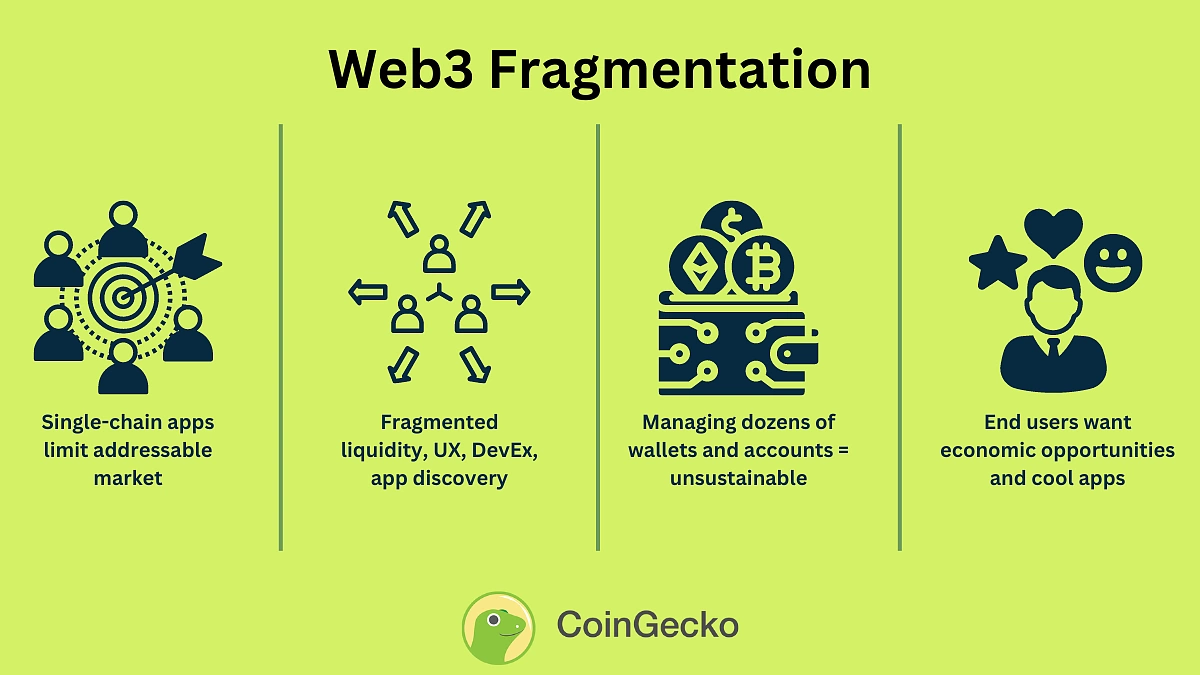
Chain abstraction rewrites the rules of capital deployment by treating liquidity as a single, pooled resource rather than a collection of siloed chains. In the current fragmented landscape, capital is trapped behind network boundaries, forcing users to bridge assets and manage separate gas tokens for every chain they wish to use. This friction creates inefficiency, leaving significant capital idle while users navigate complex multi-step workflows.
Abstracting chains allows liquidity to pool logically. Instead of locking funds in isolated pools on Ethereum, Arbitrum, or Solana, unified liquidity protocols enable a single asset to be utilized across multiple environments. This improves capital efficiency by ensuring that every dollar contributes to depth and liquidity across the entire ecosystem, not just one specific chain. The result is tighter spreads, lower slippage, and a more resilient market structure that doesn't collapse when activity shifts to a different network.
For the user, this translates to a native experience. You no longer need to switch networks or hold multiple tokens to pay for gas. The system handles the routing and settlement in the background, allowing you to interact with dApps as if you were on a single, unified chain. This removes the cognitive load that currently prevents mass adoption of DeFi.
The shift from fragmented to unified liquidity is best understood by comparing the traditional multi-chain workflow with the abstracted approach.
| Feature | Traditional Multi-Chain | Unified Liquidity |
|---|---|---|
| Asset Movement | Manual bridging required | Native usage across chains |
| Gas Fees | Separate native token per chain | Single token payment |
| User Experience | Network switching and approvals | Single sign-in and flow |
| Capital Efficiency | Siloed liquidity pools | Pooled logical liquidity |
This architectural change reduces the barriers to entry for everyday users while providing institutions with the depth they need for large-scale operations. By eliminating the need for manual bridging and network management, chain abstraction turns a complex, multi-step process into a seamless interaction.
Key protocols driving the shift
Chain abstraction is no longer just a theoretical concept; it is being built by infrastructure players who are constructing the technical rails for cross-chain interaction. Protocols like NEAR, Connext, and Particle Network are moving beyond simple bridging to create unified execution environments. These platforms allow users to interact with decentralized applications without worrying about which specific blockchain layer they are on.
NEAR Protocol: Unified Execution
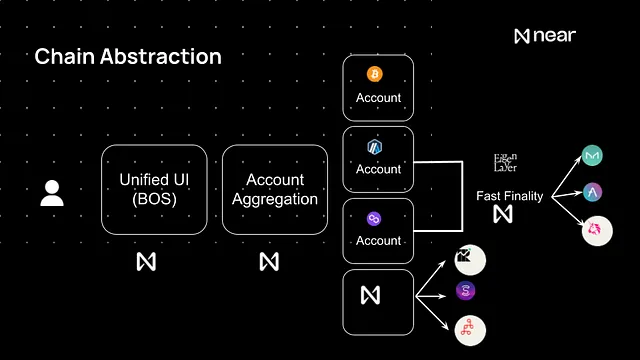
NEAR Protocol approaches chain abstraction through its Unified Computing Model. Instead of forcing users to manage separate accounts and tokens across different shards or chains, NEAR allows developers to write smart contracts that can seamlessly operate across the entire ecosystem. This reduces the cognitive load for users, who no longer need to manually swap tokens or bridge assets to interact with a dApp. The focus is on making the underlying complexity invisible to the end user, treating the network as a single, cohesive resource.
Connext: Intent-Centric Interoperability
Connext Network focuses on intent-centric interoperability, allowing users to specify what they want to achieve rather than how to achieve it. Their infrastructure enables seamless interaction with dApps from any chain using any token, all without leaving the application's user interface. By decoupling the execution layer from the settlement layer, Connext handles the complex routing and messaging in the background. This approach minimizes the friction typically associated with cross-chain transactions, making the experience feel as simple as a single-chain interaction.
Particle Network: Account Abstraction Everywhere
Particle Network integrates account abstraction across multiple chains, providing a unified identity layer for Web3. This means users can manage their digital identity and assets across different blockchains using a single interface. Particle’s infrastructure supports various wallet types and authentication methods, ensuring that users can access dApps regardless of the underlying chain. By standardizing the user experience, Particle Network helps bridge the gap between fragmented blockchain ecosystems and mainstream adoption.
Market Context
The underlying volatility of the assets these protocols support highlights the need for robust abstraction layers. As shown in the chart below, Ethereum (ETH) continues to experience significant price movements, which can exacerbate user friction if not managed properly through efficient cross-chain mechanisms.
Technical requirements for developers
To build true chain abstraction, you must move beyond simple bridge integrations and adopt a stack centered on smart accounts and intent solvers. This approach shifts the burden of cross-chain complexity from the user to the backend infrastructure. The goal is to allow users to interact with your dApp from any chain using any token, without leaving your UI, as demonstrated by protocols like Connext and Everclear.
1. Implement Smart Account Abstraction
Standard EOAs (Externally Owned Accounts) are ill-suited for cross-chain interactions because they require native gas tokens on every specific chain. You must integrate ERC-4337-compatible smart accounts to enable gas sponsorship and session keys. This allows your dApp to pay transaction fees on behalf of the user in a single native currency, abstracting away the need for users to hold multiple tokens for gas.
2. Integrate Intent-Based Solvers
Chain abstraction relies on intent solvers to handle the execution path. Instead of the user manually bridging assets, they sign an intent (e.g., "Swap 1 ETH for USDC on Arbitrum"). The solver network then finds the optimal route, potentially using liquidity pools across multiple chains or atomic swaps. This decouples the user experience from the underlying settlement layer, ensuring transactions complete reliably regardless of the source chain.
3. Unify Liquidity and State
Your backend must aggregate liquidity from multiple sources to provide seamless swaps and transfers. This requires connecting to unified liquidity pools or cross-chain DEX aggregators that can route orders efficiently. By abstracting the liquidity layer, you ensure that users get competitive rates without needing to manage slippage or bridge delays manually.
Integrate ERC-4337 smart accounts into your frontend. Configure gas sponsorship so users can interact with your dApp without holding native gas tokens on the target chain.
Implement intent-based routing by connecting to solver networks. Ensure your backend can parse user intents and submit them to solvers for optimal cross-chain execution.
Connect to unified liquidity pools and cross-chain DEX aggregators. Verify that your dApp can route orders through multiple chains to ensure competitive rates and high success.
Risks and centralization trade-offs
Chain abstraction promises to hide the complexity of multi-chain interactions, but that convenience comes with a steep price: the introduction of new centralization vectors. By abstracting away the underlying blockchain mechanics, these systems often rely on off-chain relayers, solvers, and intent-centric architectures that act as critical intermediaries. This shift moves trust from decentralized code to centralized operators, creating single points of failure that did not exist in purely on-chain protocols.
The security model of intent-based systems is particularly vulnerable. When users sign intents rather than transactions, they delegate execution to third-party solvers who compete to fulfill requests. If these solvers are compromised or collude, users face counterparty risk without the direct recourse available in traditional on-chain swaps. The opacity of off-chain computation makes auditing these interactions significantly harder than reviewing transparent smart contract code.
Additionally, the reliance on centralized infrastructure for gas payments and cross-chain messaging can lead to censorship or service outages. While the user experience improves dramatically, the decentralization ethos of Web3 is eroded. Developers must weigh the seamless UX against the potential loss of sovereignty and the increased attack surface presented by these intermediary layers.
No comments yet. Be the first to share your thoughts!